

Disenchanted Unicorns: Why Monsters Still Matter
Updated: Aug 3
Why do unicorns and mythical creatures still captivate us? This essay explores what monsters - from medieval bestiaries to modern pop culture - reveal about the disenchantment of the modern world and the needs of our imaginations.

If you go hunting through the bestiaries of the Middle Ages and the encyclopaedic natural histories of the Renaissance and early Enlightenment, you’ll discover a cornucopia of fantastical beasts. Some are familiar, others seem utterly absurd: manticores, dragons, hydras, grotesque sea creatures, griffins and, of course, unicorns. To modern eyes, the scholarly attention paid to such creatures might seem faintly ridiculous.
Yet, many of these monsters have survived through the centuries. Our fascination with them continues - especially when it comes to unicorns, dragons and the like. We know they’re not real, but they’re everywhere: from toy shops to pop culture. So, why do mythical creatures like unicorns persist in modern culture? What do monsters matter and what do they symbolise in a supposedly rational age? We still crave wonder and the fantastical, even if that craving feels out of place in a rational, scientific age, of course.
But we can go deeper, if we can create bridges between mental worlds that are separated not only by time, but very different ways of interacting with reality. Today, we ask “Are these things real?” rather than “What do they mean?” Physical existence is now the gold standard. But in the medieval bestiary and even the later natural histories, no such division existed. These collections weren’t simply flawed accounts cobbled together from ancient and misleading sources, nor were they fictions. They were something else: explorations of symbols within a deeply enchanted world.
Until modernity really took hold, the world was divinely created, and everything in it was imbued with meaning. Not only was anything possible for an omnipotent Creator, but the significance of a thing, its symbolic, moral, and spiritual value, could render it ‘real’ in a very different sense to our modern, materialist definition.
Ordinary animals like hedgehogs or bears had allegorical power; exotic lands were populated with exotic beings such as unicorns and manticores. So, the bestiary monsters weren’t factual or fictional, they were something more complicated: beings in an enchanted worldview in which unicorns were entirely plausible.
For more on the histories and meanings of monsters,
see my latest book:

The Meaning-Making Power of Monsters
Monsters and mythical creatures have always emerged from human imagination - and they shape cultures in return. Once brought into being, they take on lives of their own. They migrate across cultures and centuries, through stories, images, and art. Along the way, they evolve. They acquire new meanings, take on new shapes, and become entangled with the people and places they pass through.
The unicorn is one of the most adaptable of these creatures. Its elegant simplicity makes it a blank canvas onto which we can project a vast array of meanings. It has been imagined as a brutish beast brawling with elephants; a noble and dangerous creature tamed only by a virgin; a fierce male spirit bridled by courtly love; a panacea for all ills; or simply a strange curiosity. In Christian iconography, it was both Christ, the deliverer from poison, and the pure, divine justice of God.
This is the power of the unicorn: it can be anything we need it to be. That’s still true today. In recent times, the unicorn re-emerged as a symbol of queer liberation, draped in rainbows. Its extraordinary, otherworldly quality made it the perfect emblem of freedom, uniqueness, and pride.
But unicorns have also arguably sold out. They’ve become sugary, neutered creatures for everyone—a pastel mascot of mass-produced fantasy. Today’s unicorn represents a retreat into childhood: a shortcut to a safe, sparkly world where nothing bad happens and you never have to grow up. As Unikitty from The LEGO Movie declares: “There are no bedtimes, no frowny faces, no bushy moustaches, and no negativity of any kind.” Unicorn Land doesn’t allow sadness—only glitter, smiles, and sugary joy.
Yet even Unikitty eventually erupts in a volcano of suppressed rage. The ancient ferocity of the unicorn is still there, buried beneath the glitter. The fantasy may be a balm - but it’s also a mask.
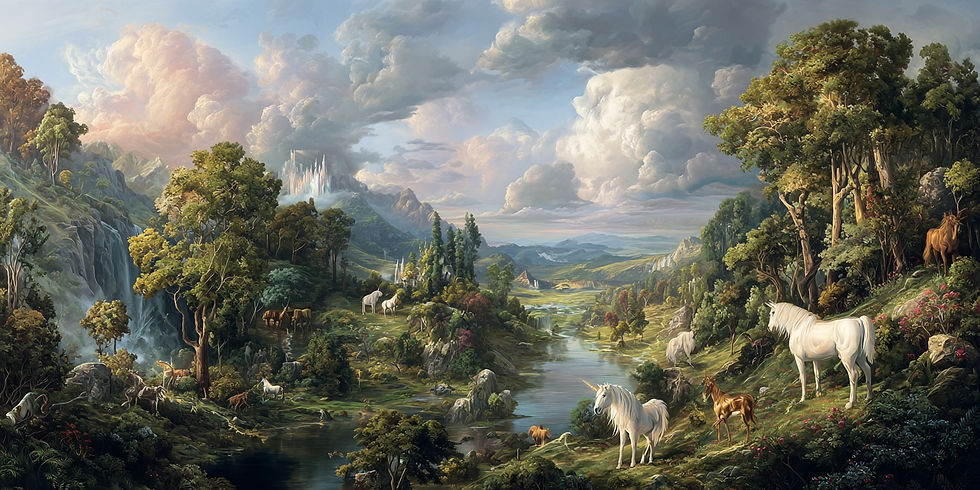
Monsters in a Disenchanted Age
The unicorn’s transformation from wild, exotic monster to commercialised sparkle-beast tells us something profound about what we’ve lost. In a world ruled by materialist logic and scientific rationality, wonder has become something we outsource to shallow fictions, not something we allow into our daily lives.
Some say that we live in a disenchanted age, in which myth, mystery, and even religious ritual have been stripped of their power. Scientific rationality is king, and anything outside of its remit is often dismissed as irrational or worthless.
We are not purely rational beings, though. The same unconscious imagination that fuels scientific creativity also generates our monsters. Whole realms of human experience—emotional, symbolic, ecstatic—lie beyond the reach of scientific instruments. If we deny those realms, we cut ourselves off from a vital part of what makes us human.
The world we inhabit isn’t just the physical one, composed of atoms and forces. It’s also our subjective experience, shaped by meaning and story. Monsters, especially the mythical kinds, are vessels for the irrational, the mystical, and the unspeakable. When we deny these aspects of ourselves, we don’t adhere to a greater rationality—we drive them underground. They can become more terrible monsters still, that return and wreak havoc. Our stalwart efforts to strip away this layer of existence has bred a clutch of modern monsters, forged from alienation, psychosis, and apocalyptic despair: the zombies, serial killers and vicious ghosts.
To cut off our capacity for wonder, to insist that we must understand before we can feel, is to impoverish our inner lives. We crave wonder—we seek it in fantasy films, in epic nature documentaries, in the surreal corners of the internet. But we rarely allow ourselves to experience it directly, in the world around us.
The unicorn, however degraded by consumer culture, is a flicker of that capacity. Studying monsters doesn’t mean retreating into fantasy. It means reconnecting with older, imaginative ways of understanding the world and what they can still offer us today. It means exploring how the monsters of our past can illuminate the present and help shape our future.

Discover more of the unicorn's strange history
If you’re interested in how monsters have evolved over time and what they say about us, you might enjoy some of my other writing and my latest book, Enchanted Creatures: Our Monsters and Their Meanings

Why monsters matter -- Copyright Natalie Lawrence 2026


Comments